
Comparison Planradar / FOLW
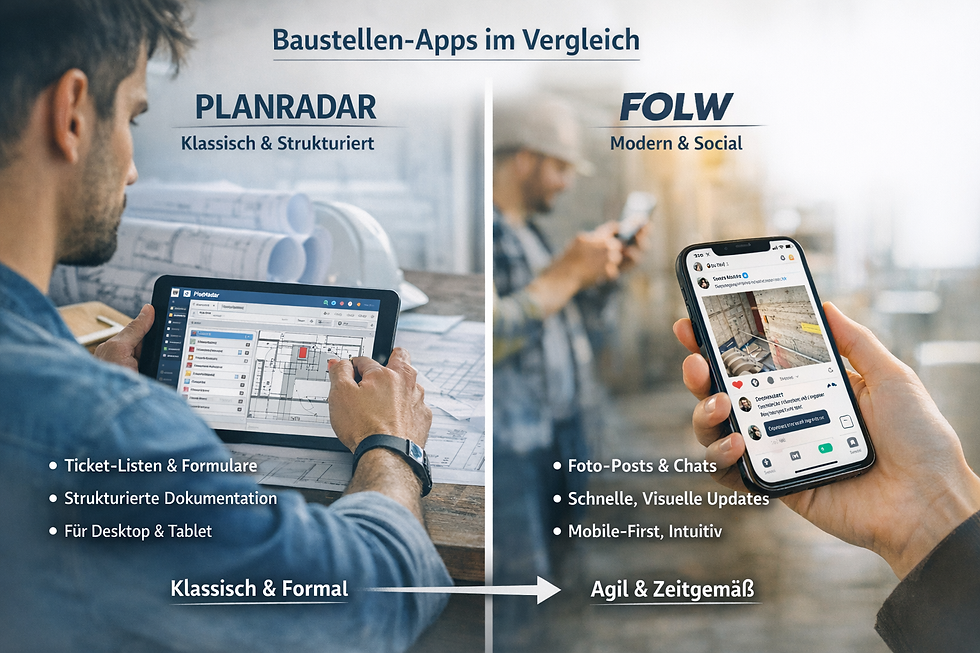
A comparison between PlanRadar and FOLW from the perspective of modern young architects reveals a fundamental shift in expectations for construction site apps: away from classic documentation and ticketing tools towards intuitive, social media-like working environments that focus on speed, clarity and collaborative work.
Comparison of Planradar with FOLW
PlanRadar is an established industry standard for digital defect and construction documentation management. The platform offers a comprehensive structure for tickets, a construction log, plan management, and communication. Tasks or defects can be located directly on digital plans, supplemented with photos, audio, or text, and forwarded to project stakeholders in real time. This creates documentation and a transparent flow of information between the construction site and the office. (App Store) This functional logic follows a classic project management paradigm: structured data collection, clear hierarchies, controlled workflows, and exportable reports. This structure is crucial, especially for larger construction projects with many stakeholders, as it enables traceability, versioning, and documentation. (App Store)
From the perspective of modern, young architects, however, a different user behavior is becoming increasingly apparent. The generation under 40 has grown up with Instagram, WhatsApp, Notion, or Figma and expects a similar user interface from digital tools: intuitive, visual, fast, mobile-first, and without lengthy training phases. This is where FOLW comes in.
While PlanRadar is functionally robust, FOLW positions itself as an agile, intuitive, visionary, and contemporary construction site app with a user interface strongly reminiscent of social media platforms. Interaction also takes place via complex ticket forms, but additionally through direct visual communication, rapid status updates, and streamlined click paths.
For young architects, this means a crucial difference in their daily workflow. PlanRadar is based on the classic project structure: a defect is created as a ticket, categorized, prioritized, and assigned. This process is precise but comparatively formalized. FOLW, on the other hand, relies more heavily on image-based, immediate interactions: take a photo, tag it, comment, and send it – similar to a story or chat function. This lowers the cognitive barrier to entry, and information is also quickly captured and shared. Especially on dynamic construction sites with many parallel decisions, speed is a key factor.
Another aspect is the expectation of mobile usability. Young architects are increasingly working directly from their smartphones or tablets, no longer primarily from desktops. They expect an app that feels like a native social app, with smooth navigation, gesture control, and a clear visual hierarchy. While PlanRadar offers a mobile app and enables real-time synchronization and photo documentation, its user interface remains more closely aligned with traditional project management software. (App Store) FOLW, on the other hand, explicitly addresses the need for a "mobile-first" experience: fewer menus, fewer forms, more direct visual communication, and an interface that resembles a feed rather than a database.
Communication culture has also changed. Young architects prefer quick, informal coordination to long email chains or formal protocols. They are accustomed to commenting on, liking, tagging, or forwarding information in real time. A construction site app that supports this dynamic not only increases efficiency but also team acceptance. While classic tools like PlanRadar fulfill documentation requirements, they often feel like administrative instruments in daily use. FOLW, on the other hand, positions itself as a communication and collaboration platform that generates documentation almost incidentally—an approach that better reflects the behavior of modern users.
Another key point is the emotional perception of software. Young architects today expect not only functionality but also an appealing user experience design. They subconsciously compare business software to consumer apps. A modern, visually clean, and minimalist interface is perceived as more efficient and "easier," even if the range of functions is similar. Here, PlanRadar appears functional and robust, but more traditional, while FOLW is perceived as innovative, agile, and contemporary.
PlanRadar remains a structured tool for construction documentation and defect management with comprehensive functions. It continues to be highly relevant for large projects and traditional organizational structures. FOLW, on the other hand, is also suitable for large projects but resonates more with modern, young architects who prefer fast, visual, and social-media-like workflows. The app meets the need for intuitive operation, real-time communication, and minimal administrative effort.
The real difference, therefore, lies less in the core functions than in the user interface philosophy: PlanRadar represents structured digital construction management, while FOLW stands for a new generation of construction site apps that are geared towards the behavior of digitally socialized users and generate efficiency through intuitive interaction. This shift reflects the fundamental change in the work culture of young architects – away from formal tools towards fluid, communicative, and visually driven work platforms.


Comments